One Hour of Battery After The Machines Stop
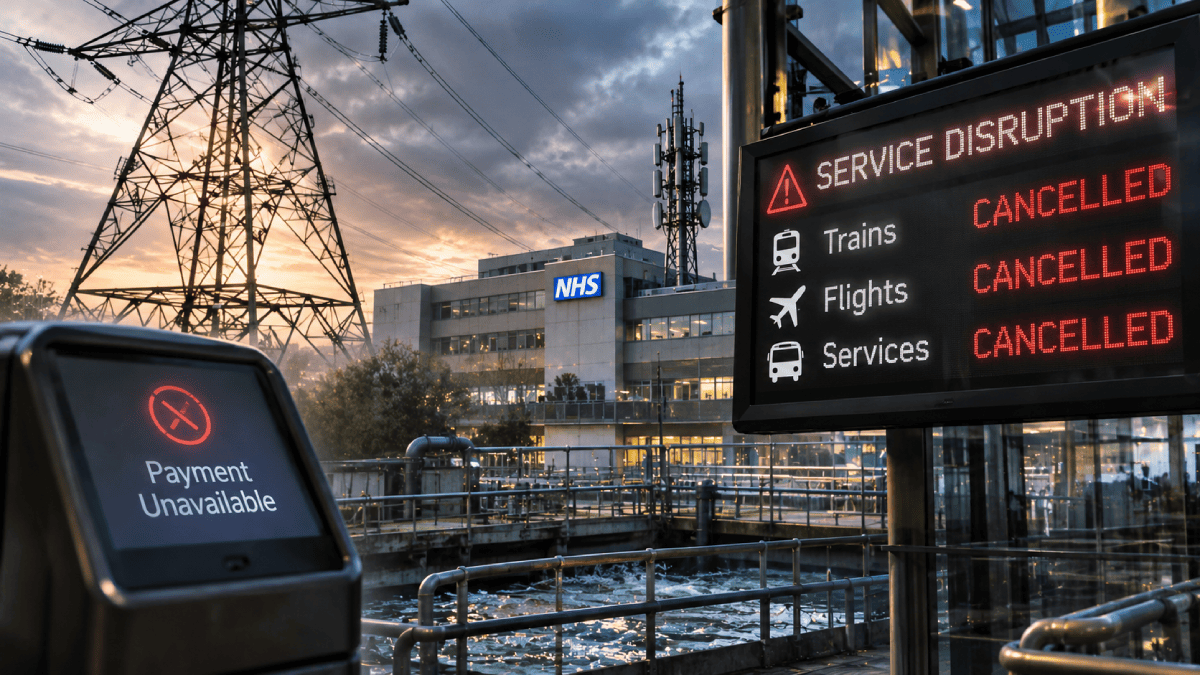
A wet transformer shut Heathrow. A flooded substation cost Lancaster its phones, cash machines, and petrol pumps in a day. Whitehall's own plans allow for a week without mains power and months of repairs. Ask what happens to everything else in the meantime and the answers get thin.

Guy Fawkes needed a cellar, a fuse, and a great deal of gunpowder. Modern Britain can do comparable damage to the machinery of state with an oil sample left unanswered for nearly seven years.
In July 2018 a test on a transformer at the North Hyde substation in west London found too much moisture. The response did not match the reading. A National Grid review found the site's fire suppression system inoperable in 2022, and a later assessment found it still out of service in July 2024.
At 23:21 on 20th March 2025 the transformer tripped and caught fire.
By morning, Heathrow was shut.
Over 70,000 customers and businesses lost supply. About 42,000 were back within an hour, and every domestic customer by 12:24 the next day.
The electricity network recovered well. Aviation went on suffering for days.
Heathrow's private wiring meant the loss of one supply point out of three took down critical systems, and its fix took 10 to 12 hours and was unknown to the energy companies.
The fire also hit Hillingdon Hospital, roads, and rail, and residents were evacuated from their homes.
One transformer became an international transport event because one system quietly leaned on another, and hardly anybody knew. What needs to be thought about is the same logic through electricity, telephones, water, fuel, food, and money in the same week.
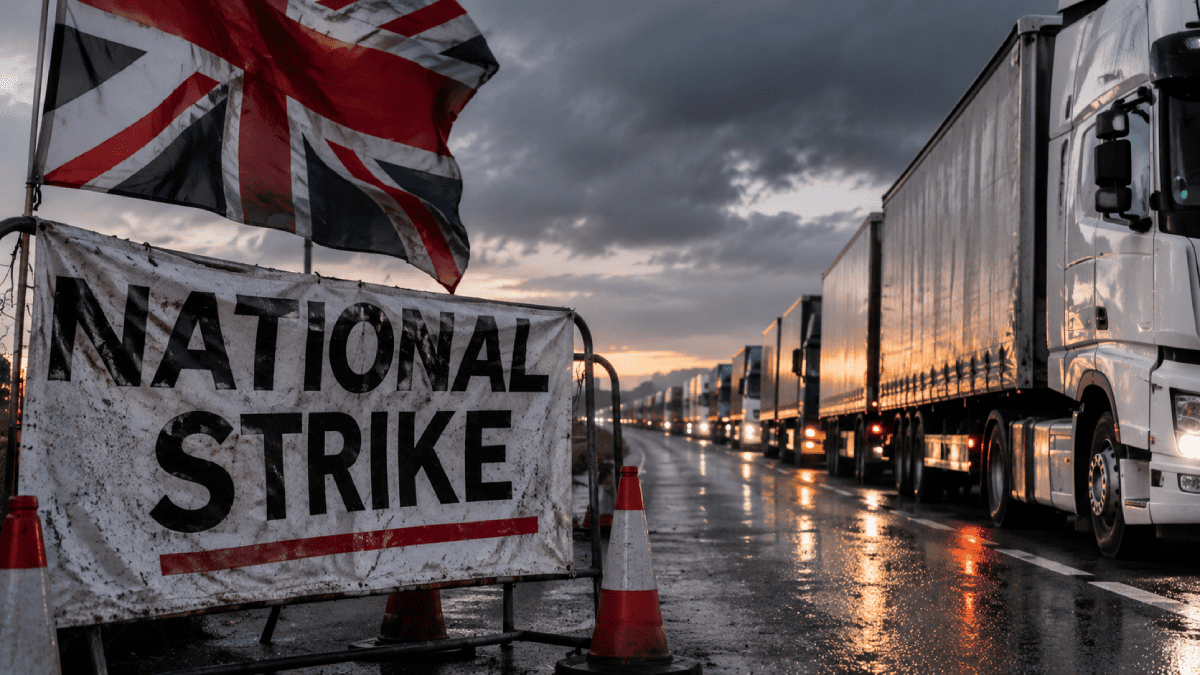
Monday's figures showed how little deployable state power sits behind the headline numbers. Tuesday's showed what happens when the lorries stop.
Both assumed the infrastructure underneath modern life keeps running.
Remove that assumption and a harder test appears: how long a country this dependent can last before an engineering emergency turns into a social and political one.
The published evidence suggests the answer is measured in days.
13 Sectors All Leaning On Each Other
The government which faced the Chartists in 1848 ran mostly on paper, horses, and coal. By modern standards it was a feeble thing. It also had very little to lose when something snapped.
Today's state has instant communications, digital administration, electronic banking, central databases, a national grid, modern hospitals, and high-speed transport. Every one of these is a real gain in power.
Every one is also a new way for the state to stop working.
Britain recognises 13 Critical National Infrastructure sectors:
- chemicals
- civil nuclear
- communications
- defence
- emergency services
- energy
- finance
- food
- government
- health
- space
- transport
- water
The important point is the connection between them.
The government's Resilience Action Plan of July 2025 warns failure could bring "cascading and catastrophic consequences", and gives its own examples: power cuts hitting transport and water, and telecoms or data failures hitting the energy sector.
Those words come from the Cabinet Office, not from a man with a sandwich board.
Whitehall Has Wargamed The Worst Week
The National Risk Register sets out a worst case for total failure of the national transmission system. It assumes winter.
- Anyone without a backup generator loses mains power instantly and without warning.
- Mobile and internet services, water, sewage, fuel, and gas all suffer.
- Public services, businesses, and households are badly disrupted.
- People die.
Extreme weather, a cyber attack, or a chain of technical faults could each be the cause.
Government rates the impact as catastrophic, the top of its scale.
It also publishes the clock.
Small pockets get intermittent power within a few hours. A significant share of demand returns within a few days as a "skeletal network".
Full restoration could take up to seven days. Depending on the damage, critical services could take several months.
The 2026 register's entry for a cyber attack on the grid is blunter still: full restoration "could take at least 7 days".
Whether the electricity comes back is the easy part.
The hard part is what happens to everything else while Britain waits.
Eight weeks from now, on 31st December 2026, the Electricity System Restoration Standard takes effect. It requires the capability to restore 60% of demand in every region within 24 hours and all of it within five days.
In the assurance framework published in December 2025, the National Energy System Operator put the modelled average at 33.7 hours for the first target and 97 hours for the second.
The second clears the bar. The first misses it by nearly ten hours. The operator says changes under way will close the gap, chiefly faster reconnection of blocks of demand, and it may be right.
Its own paperwork makes less soothing reading. A total shutdown has never happened here, so performance rests on probabilistic modelling. The operator has admitted it has no reliable understanding of what demand will look like after one.
Its latest risk table gives a likelihood of four out of five to its modelling assumptions drifting out of line with reality. Those assumptions were first set by an industry group which no longer meets.
Spain and Portugal took the live test in April 2025 when their grids were rebuilt in roughly 16 hours, helped by hydro plants and imports from France and Morocco. In those hours some 35,000 people were rescued from stranded trains and metros. Authorities investigated deaths linked to the blackout. Three members of one family died of suspected carbon monoxide poisoning beside a generator running an oxygen machine. A woman in Valencia died after problems with her oxygen machine, and another died in a Madrid fire blamed on a candle.
Sixteen hours was a good result, and people still died.
The 2015 Lancaster Catastrophe
At 10.45pm on 5th December 2015, floodwater forced the shutdown of Lancaster's main substation and 61,000 properties lost power. A second failure on the Monday cut most of them off again.
The Royal Academy of Engineering wrote up what followed, and it should be compulsory reading for every engineer and minister.
- Most mobile coverage went within an hour.
- The internet went.
- Card payments and most cash machines went.
- Digital radio went.
- Petrol stations could not pump.
- Gas central heating failed, because its pumps and controls run on electricity.
- Electric cookers were useless.
- Upper floors in some new flats lost their water and could not flush.
After 30 hours, people were throwing out the contents of their freezers. One supermarket with a generator traded in cash only, then closed at 4pm because of Sunday trading law, and nobody could say who had the authority to waive it.
The care home fared worse.
Laurel Bank lost heat, hot water, lights, lifts, and alarms. Staff lifted infirm residents by hand because the hoists had died. The gas cookers would not run because they were interlocked with electric extractor fans, so the chef built a barbecue in the garden in the tail of a storm.
One common complaint fitted in five words: "no one told us anything".
A Gold Command briefed the emergency services.
Head teachers, responsible for hundreds of children, were left with a Twitter feed which did not work in the blackout area. One school announced its closure in marker pen on a pillowcase tied to the railings. A garbled message sent several hundred overseas students to the police station expecting transport.
Lancaster also had every advantage a disaster can offer. The power went on a Saturday night. Sunday was mild and sunny. The rest of the country was working, which is why 75 large generators could be found and driven in from as far as the West Country and Northern Ireland.
The report notes 750 for Birmingham would be a different order of problem, and a national restart two orders beyond that. Britain has since had other rehearsals.
Storm Arwen in 2021 left about 40,000 customers without supply for more than three days and nearly 4,000 for over a week.
The week in the dark is already a British experience. It has just never happened to everyone at once.
Power , Phones, Repair
Copper landlines draw power from the exchange. Their digital replacements draw it from the house. Ofcom requires providers to give vulnerable customers who depend on a landline a solution lasting at least one hour. Better kit reaches four to seven hours. For a household with no other way to reach a 999 operator, one hour is the regulatory minimum.
Telecoms does not all fall over at the 60-minute mark, and the core is better protected. Ofcom's guidance now expects core sites to survive five days without power.
The trouble sits at the edge, where people are. Ofcom's own analysis found around 20% of mast sites have backup for at least an hour, and only 5% for at least six.
With phones roaming onto whichever network survives, the first figure keeps about two thirds of the population able to make an emergency call in an outage of up to an hour. The share still able to call at six hours is blanked out of the published report.
Its revised guidance of June 2026 sets no fixed number of hours for masts. An hour at every site was priced at £0.9 billion to £1.8 billion, and the operators objected.
The grid operator knows what this means for its own work.
Its consultation on restoration told the industry mobiles and landlines may only function for a short period after a national outage, and asked whether firms had automated around the problem. Power fails, communications degrade, and coordinating the restoration of power gets harder.
That loop closes within hours.
The Cabinet Office's plan in a national outage is to send an Emergency Alert telling people to tune to Radio 2 and Radio 4.
- The alert needs a working phone mast.
- The radio needs a household which still owns a battery set, and Lancaster showed many do not.
- Radio 4 long wave, the old national lifeline, went off the air for good on 27th June 2026.
When fire took the Bilsdale mast in August 2021, around 670,000 homes lost the transmitter serving them, and the temporary mast did not arrive until October.
When the Shefa-2 subsea cable broke in October 2025, some Shetland customers went 26 days without service, because for their network it was a single point of failure.
The emergency call system needs no storm at all. On 25th June 2023 a BT fault disrupted 14,000 emergency calls over ten and a half hours, made worse because the switch to the backup platform relied on poorly documented instructions and an unfamiliar team.
Ten Litres Of Water A Day Per Person
People can put up with cold, boredom, and a dead phone for longer than they can put up with dry taps and blocked toilets. Ofwat's rule is plain. When piped supply fails, companies must provide at least 10 litres per person per day within the first 24 hours and keep doing so until supply returns.
Planning guidance raises this to 20 litres after five days.
Ten litres sounds modest until it is treated as freight.
The following is arithmetic from the minimum standard, not a forecast of any incident.
- For 100,000 people the requirement is 1 million litres every day.
- For one million people it is 10 million litres, or about 10,000 tonnes.
- At an assumed 26 tonnes of payload per articulated lorry, that is close to 400 loads a day, every day, before a single hospital or care home has been served.
- After day five it doubles.
The water exists. The problem is moving it to people while the event which cut their supply is also disrupting roads, diesel, and telephones.
Those lorries are the ones Tuesday took off the road.
South East Water has spent the past year showing how this goes at a tiny fraction of the scale. In the winter of 2025 to 2026, 24,000 properties in Tunbridge Wells spent days with no running water and almost two weeks without drinkable water.
Weeks later Kent declared a major incident after Storm Goretti and a power cut at a pumping plant took out tens of thousands more, and the company was sending tankers to hospitals.
Up to 70,000 homes were hit between November and January.
In July 2026 an instrument failure at one treatment works left 7,000 properties with low pressure or nothing.
One regional company, one weather system, one instrument, and bottled water stations in car parks.
Compounding Circular Fuel Failure
Backup power is a promise which means diesel. When the mains go, every hospital, exchange, data centre, and pumping station with a generator starts burning fuel at once. Demand for fuel rises at the moment the means of selling it stop.
Lancaster's garages could not pump. Its bus depot kept running only because it had held on to some hand pumps.
- Generator supply needs tankers.
- Tankers need drivers, working depots, and open roads.
- Drivers need instructions, which need telephones, which need power, which needs generators.
Each backup is sound on its own drawing board. Laid end to end they form a circle.
Generators can also just fail.
During the brief power cut of 9th August 2019, which hit over a million customers, a backup generator at Ipswich Hospital failed to work as expected. That cut lasted under an hour, yet rail disruption ran on into the Sunday.
Half The Food Needs A Fridge
Around half of the UK's food relies on the cold chain: chilled and frozen stores, vehicles, and depots. It runs on just-in-time models, and its trade body warns chilled and frozen products can spoil within hours if cold stores lose power with no priority for reconnection.
A week without mains would mean a great deal of food being thrown away at the moment it is most needed, with the household freezer going the same way on a slightly longer fuse.
The National Audit Office reported on this in September 2026, and the result is a horror story written in the driest prose in Whitehall.
A national exercise in 2023 found many response plans across government would not be sufficient for a national power outage, and recommended detailed national plans for key sectors, food among them.
Defra judged a full emergency plan for food too costly for the risk, and is writing a more basic one. No specific food supply asset sits in the government's database of critical infrastructure.
Defra's Food Supply Chain Resilience team numbered 6.5 full-time staff until May 2026, when it rose to 16.5. Defra cannot direct businesses to act in an emergency. Most Local Resilience Forums do not plan specifically for food disruption.
In 2025 Defra itself reported "very little confidence" in the joined-up working of cross-government infrastructure governance.
Food is one of the 13 critical sectors, and Britain produces around 60% of what it eats, measured in money.
Until this May, six and a half people were minding the failure plan for it.
The Banks Have Already Prepared
Payments are the best news in British resilience, because of course. The Bank of England treats payment disruption as a financial stability issue. Its settlement system handles over £800 billion on an average working day, and the standing tolerance is plain: critical payments must be made on the day they fall due.
On 14th August 2023 a six-hour disruption stopped settlement, and everything still cleared by close of day.
On 18th July 2024 a problem at the messaging provider Swift took CHAPS settlement out for 245 minutes, with the same result.
The Bank lists further disruptions in 2024 and 2025, all settled within tolerance, and it took part in an industry simulation of a national power outage.
A sophisticated system can take a substantial hit and recover without drama. Each of those hits came alone, on a normal day, with the staff at their desks and the lights on. The Bank knows this.
Its June 2026 statement expects operators to consider what happens if "more than one important business service" is disrupted at once.
The word for this is concurrency.
At street level the stakes are simple. Government's scenario for a failed retail bank would hit people's ability to buy necessities, get to work, and pay utilities, with longer effects lasting weeks.
Payments are infrastructure, and a card reader is one more thing needing mains and signal.
Hospitals Move The Dependency Around
No universal figure exists for hospital generator fuel, because NHS sites differ. Royal Lancaster Infirmary had duplicated generators and 14 days of fuel, and on paper it should have carried on as normal. It was swamped anyway.
With GPs, the 111 line, and pharmacies disrupted, everybody came to A&E.
People rang to ask where to find paracetamol and how to heat baked beans. Home dialysis patients needed help. Repeat prescriptions landed on the hospital pharmacy. Students arrived with an extension lead looking for a socket.
Hospital resilience moves dependence around without removing it.
Mains is swapped for generators, generators for fuel, fuel for tankers. A hospital also depends on water, medical gases, digital records, drug deliveries, food, waste collection, and staff who can get to work.
The ransomware attack on the pathology supplier Synnovis in June 2024 needed no power cut. More than 800 planned operations and 700 outpatient appointments were cancelled at two trusts in a week, blood testing broke down, and a patient's death was later linked in part to a long wait for a result.
One compromised supplier did that.
Meanwhile the patients the NHS has sent home turn back into patients. Lancaster showed how: oxygen, dialysis, stairlifts, hoists, and personal alarms all run on the mains, and several hundred alarms firing together overwhelm the call centre.
Care delivered at home saves beds on a good day.
On a bad one it creates thousands of small emergencies, in private, behind doors nobody knows to knock on.
Police Draw The Most Of All
Police, ambulance, and fire services consume the same electricity, fuel, telecoms, digital records, navigation, and staff transport as everyone else. Whitehall only added cyber attacks on police systems to the National Risk Register this July.
The disastrous programme to replace the emergency services' radio network had swallowed almost £2 billion by 2023 with no firm completion date. Crews sit in the same fuel queues, and their children attend the same closed schools.
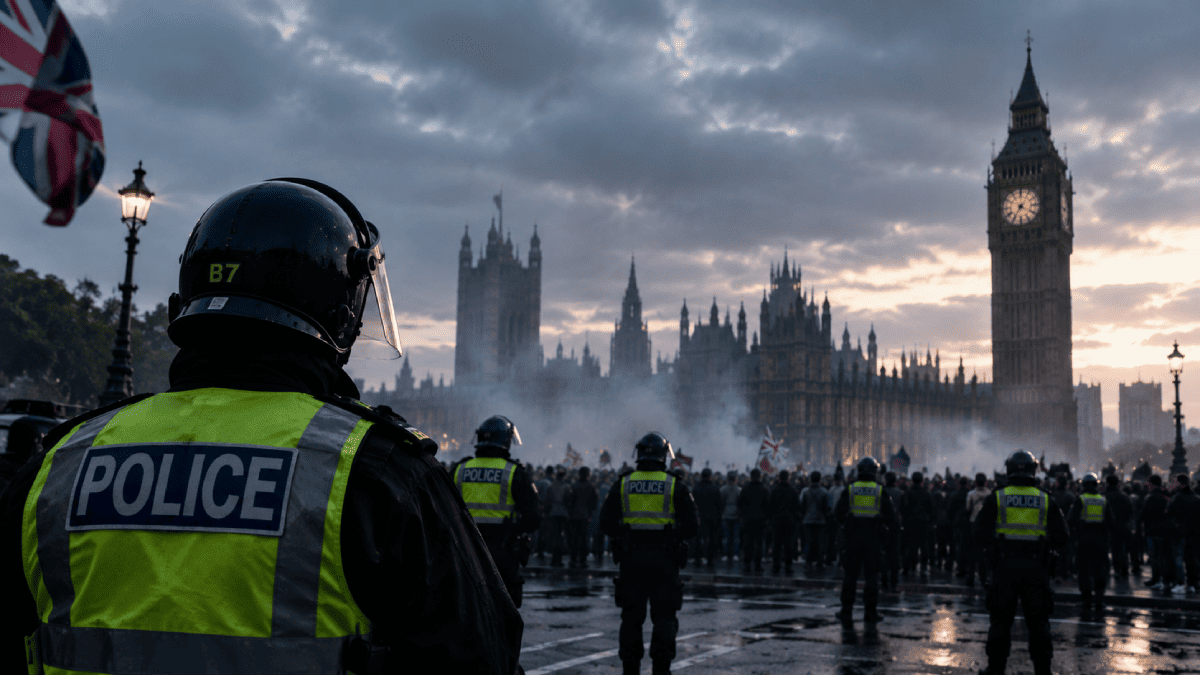
Monday established how few specialist public order officers exist.
Tuesday showed logistics seizing up.
An infrastructure crisis adds the worst combination of all: it generates new calls for police and emergency services while making it harder for those services to work.
Lancaster needed police teams drafted in from surrounding areas to reassure residents and find vulnerable people, and it could borrow them because the surrounding areas were fine.
In a national failure there is no surrounding area.
The government's own plan concedes the point. In widespread power and water outages, it says, the authorities may not be able to reach everyone who needs support in the first few hours or days.
From Repair Job To Government Rationing
No incident follows a timetable, and any two towns will differ. The stages overlap, and none of them is a prediction.
| Period | What is happening | Who is carrying it |
|---|---|---|
| Hours | Power or another service stops. Batteries, generators, and stored supplies take over. Institutions remain intact. | Engineers and continuity plans |
| First day | Some services hold, others close. People travel looking for fuel, food, cash, power, signal, and news. Welfare checks and traffic control begin. | Households, with responders in support |
| Days 2 to 3 | Batteries are flat. Generators need resupply. Shelves thin. Signal gets patchier. Emergency water is needed. Medical and care problems pile up. | Every sector at once |
| Days 4 to 7 | Government is managing distribution, queues, welfare, information, security, priority access, emergency shelter, and health. | The state directly |
Society does not collapse on a set hour. Lancaster saw only low-level opportunistic theft and a good deal of generosity. Anarchy won't appear by Tuesday lunchtime.
The useful threshold lies elsewhere: the point at which ordinary self-help stops absorbing the disruption and the state must begin directly allocating scarce essentials.
While households and firms can improvise, government coordinates.
Once millions depend on emergency distribution, government decides. It decides who gets fuel first, where the water goes, which transport runs, which hospital functions come first, and which areas get power back first.
The NAO reports British households are less prepared than those in several comparable countries, which brings the threshold forward.
Those decisions are political, whatever the engineers call them.
People will accept severe hardship if they believe restoration is competent and allocation is fair.
The same hardship turns explosive once they believe another district, institution, or group is being served first.
Government has already published an awkward clue in its planning assumptions, which say rural areas are likely to get power before urban ones, and northern regions may get it sooner too, for sound reasons of network design and generation.
Try explaining sound reasons of network design on day four to a dark, cold, thirsty inner city watching the countryside light up on the one phone still working.
A Minister Cannot Recharge A Battery
The vile Civil Contingencies Act 2004 reads like a checklist for all of the above. It defines an emergency to include disruption of a supply of money, food, water, energy, or fuel, of a system of communication, of transport, or of health services.
Public bodies have duties to assess these risks and keep plans. Ministers can make emergency regulations to protect or restore them.
Legal authority cannot stand in for physical capability for long:
- A minister can prioritise emergency water, and somebody still has to bottle, carry, and hand it over.
- Government can prioritise generator fuel, and somebody still has to drive it.
- Regulations can protect telecommunications, and they cannot recharge millions of batteries.
Emergency regulations may not require military service and may not prohibit strikes.
The government admits it has few legislative means for rapid, non-consensual intervention in company behaviour which may give rise to an emergency. After Southport, the Act is under review, with a report due in March 2027.
The Real Reserve Behind The Reserve
The state's true emergency reserve appears on no establishment table. Utility repair crews, telecoms engineers, fuel tanker drivers, water company staff, and cyber specialists are all state capacity in a crisis.
Almost none of them work for the state. They work for firms which have spent decades being told to run lean, and the operator responsible for the restart rates too few resources, driven by attrition and retention, as a live risk at three out of five.
Lancaster Corporation once ran gas, water, trams, and electricity, and could move staff between them. Decades of reorganisation left a web of contractors with nobody holding an overall view of the system.
A system built for efficiency performs beautifully for 99% of the time. The other 1% does not appear in the accounts.
The pattern of recent failures is damning, because so few were bolts from the blue.
| Failure | What had been left undone | Result |
|---|---|---|
| North Hyde, March 2025 | Moisture reading from 2018 not properly acted on | Heathrow shut, over 70,000 customers off supply |
| BT 999 service, June 2023 | Backup procedures poorly documented | 14,000 emergency calls disrupted, £17.5 million fine |
| Bilsdale mast, August 2021 | No site-specific emergency plan | Weeks of lost TV and radio across a region |
| Shefa-2 cable, 2025 | Alternative route not yet connected | Up to 26 days offline for some Shetland customers |
| South East Water, 2025 to 2026 | Worst for supply interruptions as far back as 2023 | Repeat outages, £30.5 million redress package |
At the time of North Hyde, network operators were not generally aware which of their customers were critical infrastructure, and those sites had no priority in electricity regulation.
The state had listed 13 sectors as vital and had not told the people keeping them powered.
It Breaks When The Backup Can't Function
Britain has never had a nationwide loss of power. Government calls the likelihood low and the system among the most reliable in the world, and the record supports it.
The operator reports 83% of generator capacity confirmed as able to ride out 72 hours without external supply, and enough compliant generators to meet the targets.
The payment system has recovered within the day every time.
Water companies carry a hard legal duty.
The food trade kept shelves stocked through Covid, Ukraine, and cyber attacks with little help from anybody.
Lancaster's neighbours fed each other.
The government is mapping dependencies between sectors and has built a far more serious resilience apparatus than it had before Covid.
Britain is a system of systems, and its strength comes from redundancy, backups, skilled operators, alternate routes, and quick recovery.
Its weakness appears when the backups rest on something else which is also failing. Generators need fuel. Fuel delivery needs roads and drivers. Drivers need communications and payment. Communications need electricity. Water needs pumps and power. Hospitals need all of them.
One stopped machine is a repair job.
A modern state enters real danger when the systems built to cover for each other start failing together, and Whitehall's own planning allows up to seven days of that for electricity alone, with months more for some critical services.
Here Marks The Survival Line
Take a week of political anger and logistical strain. Add unreliable electricity, patchy phones, thin fuel, failing payments, and tankers of water arriving at some streets and not at others.
By the Thursday of a week like that, the machinery is no longer the only thing in need of repair.
The police are stretched and tired. The population is angry. Different communities have seen the same crisis differently, and each suspects the other is being looked after first.
Westminster is under mass political pressure, and ministers have begun to look past an exhausted police service to the Army.
Can one common public order hold under those conditions?
The answer marks the line between an infrastructure failure and a constitutional crisis.