Childless Spinster HR Politics And Fantasy Romance Casting
Canada bought a haircut in 2015 and spent nine years paying for it. Britain has now installed a prime minister reviewed like a reality show contestant, by a press more interested in his lashes than his borrowing. Equal suffrage was supposed to bring equal scrutiny.
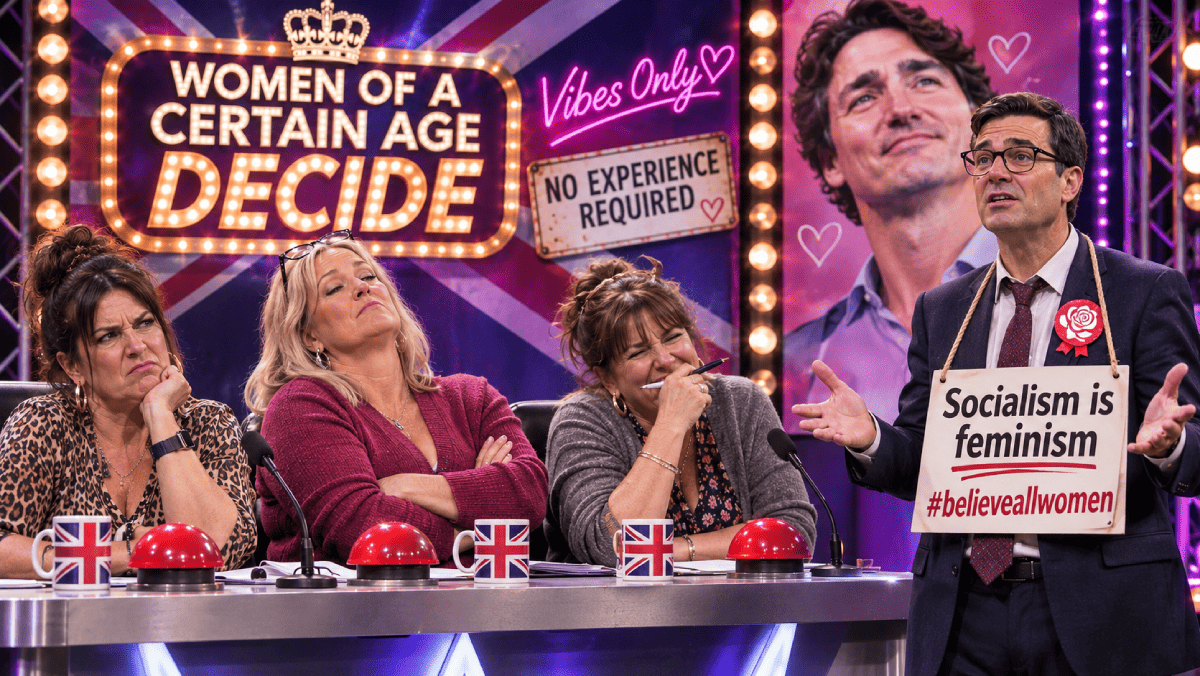
The Times of London is the worst serious publication in Britain, and it can no longer be called a newspaper. It is apparently now crafted as daily women's magazine for female civil servants, focusing on feminist politics, with some obituaries to pad the girlboss-fawning and establishment attacks on Farage. Which is almost certainly why no-one reads it anymore: By 2010 its circulation had collapsed and the current estimate is its suicidal paywall is only just starting to beat its anaemic 120,000 copies a day.
An example of the rot is a bizarre apologism celebrating female violence published this week which is so on the nose it really drives past parody. Titled, "Why smashing up a room is all the rage for Britain’s angry women", it copies the Guardian's same article from a year ago but reads:
A drop in oestrogen can lead to rising levels of anger and one business giving that fury an outlet has seen women aged over 40 are among its best customers.
Indeed. Quite.
In May 2015 the Conservative Party of Canada released an attack advertisement called The Interview. Four actors sit round a boardroom table reviewing the CV of darling Justin Trudeau. He has never balanced a budget. He has never met a payroll. An older woman on the panel points out the premiership is not an entry-level job.
They decide to pass, and as the meeting breaks up a man in a suit delivers the kicker: "Nice hair, though."
Much of literary and media Canada received it as a compliment. Margaret Atwood, the country's most decorated novelist, wrote a column for the National Post treating "nice hair" as a chat-up line any woman would recognise, and accused the Conservative admen of "girlifying" Trudeau, as though resembling a girl were an insult.
When the Post briefly pulled the column, the row became a national cause with its own hashtag. Three weeks after polling day the Toronto Star ran a profile of the stylist responsible, under the headline "The Woman Behind the 'Nice Hair'".
By then Canadians had handed Trudeau a majority.
What followed deserves the same treatment the fictional hiring panel gave his CV. In December 2017 the federal ethics commissioner found he had broken four sections of the Conflict of Interest Act by accepting a free family holiday on the Aga Khan's private island, while the Aga Khan's foundation was officially lobbying his office.
In August 2019 her successor found he had broken the Act again, this time by pressing his own attorney general, Jody Wilson-Raybould, to spare the engineering giant SNC-Lavalin a criminal prosecution for fraud and bribery.
He became the first Canadian prime minister found in breach of the law twice.
In July 2017 Rolling Stone photographed him with his sleeves rolled up beneath the line "Why Can't He Be Our President?"
Canadians supplied their own answer, slowly. Approval which had held above half for his first two years, according to the Angus Reid Institute, had sunk to 22 per cent by December 2024.
On 6th January 2025 his own MPs forced him out.
The hiring panel in the advert reached its verdict in thirty seconds.
The country took nine years.
A Pair of Eyelashes And A Black T-Shirt
Britain has now cast its own leading man, and dispensed with the tiresome business of an audition in front of the public. Andy Burnham became prime minister on 20th July 2026 without a general election and without a leadership contest; enough Labour MPs nominated him to make a ballot unnecessary.
The Associated Press described him, correctly, as unelected and largely untested.
Architects of his rapid ascent, hoping to make socialism cool again after all the killing and poverty, were two women of a certain age:
- Our beloved Ange, who got back in the game.
- And convicted fraudster Louise Haigh, who was described as his "power broker."
A month earlier, at Prime Minister's Questions on 24th June, Nigerian Kemi Badenoch told the Commons Labour MPs had abandoned Keir Starmer for "a pair of eyelashes and a black T-shirt".
To her credit, no one has since offered a more precise summary of his candidacy.
Burnham answered with a five-second selfie video, fluttering his lashes at the camera and correcting her: the T-shirt was dark blue. Because, of course. How charming, for women of a certain age.
The Irish Times reported the lashes are a running Westminster joke, credited with much of his appeal to some women voters.
Stylist reported the internet loved him for the video, then laid down a rule worth reading twice.
A man, it argued, can make a joke of remarks about his looks and rise above them; criticism of a woman's appearance cannot simply be laughed off. One sex may be mocked and is expected to smile. The other is off limits.
Partiality has been given a press pass and a progressive badge.
Polling during the Makerfield by-election on 18th June found his lead emphatic among women and neck and neck among men.
Reform had helpfully selected a candidate who had claimed women "can't drive", which reduced the contest to a casting decision between a heartthrob and a pantomime villain.
Burnham took nearly 55 per cent.
Julie Burchill, who has watched more reality television than most of Westminster has read Treasury forecasts, recognised the format at once: Burnham as the Love Island "Bombshell", the late arrival who turns every head in the villa.
Did ever a picture tell a story like the selfie Burnham took in Westminster Hall shortly after Sir Keir’s resignation? Around 200 Labour MPs shamelessly showed up for the doe-eyed usurper, including Rachel Reeves, Angela Rayner, Lucy Powell and Louise Haigh,which brought back vile visions of ‘Blair’s Babes’. So female-friendly, indeed, is the soft-voiced Mr Burnham that his promoters have recently proclaimed him female in all but biological sex.
A Column Named After A Smiths Single
The Times exists, in theory, to puncture this sort of thing. Its readers pay for sobriety. As his coronation approached, its editorial board mused he might prove a "lucky prime minister" and signed off with three words fit for a greetings card:
"There is hope."
Yes, there is HRT.
When he addressed Labour's conference in September, the leader writers headlined their verdict "This Charming Man", after the Smiths, a band whose album Hatful of Hollow Burnham calls the record which changed everything.
This album was released in 1984, when women of a certain age were teenagers.
Even the paper's mild criticisms now arrive under the title of an indie single about a stranger's flattery.
The Sunday Times marked his hundredth day with four sit-down interviews. In the week of his accession The Times secured the detail every celebrity weekly covets: his father, who has Alzheimer's, did not know his son was becoming prime minister. "A whole family achievement," Burnham said.
Each of these details is affecting and belongs to the grammar of the women's weekly: the private sorrow, the proud family, the northern lad made good.
None tells the reader whether the bond market believes his arithmetic.
On the afternoon of his first day in office, government borrowing costs jumped after he spoke of using the "flexibility" in the fiscal rules.
Charm does not set the price of a ten-year gilt.
Fleet Street Has Changed Sex
Women being the larger modern consumer of literature has never changed. As men move to YouTube and AI, women now make up 53 per cent of the UK journalism workforce, according to the National Council for the Training of Journalists, against 49 per cent of the workforce as a whole.
At the top the shift is starker. The Reuters Institute found women held 46 per cent of top editorial posts at Britain's leading news brands in 2025, the highest share of the twelve countries it studied.
Britain overtook the United States to get there.
The results are clear and speak for themselves: newspapers are now full of garbage chatter and value-less pablum.
| Measure | Women |
|---|---|
| UK journalism workforce (NCTJ, 2025) | 53% |
| UK workforce overall | 49% |
| Top editors, major UK news brands (Reuters Institute, 2025) | 46% |
| Top editors, average across 12 markets | 27% |
What changed with the personnel was the test.
Political coverage once asked what a man had done, what he proposed, and who would pay. A growing share of it now asks the garbage question of how he makes the writer feel.
- In 2020 the Evening Standard declared Burnham an unlikely sex symbol, a "Debenhams Dad" whose look had "never looked so good".
- Hello! charted the style evolution of his "cool-girl" wife.
- On the day he became prime minister, Sophie Heawood recorded, her female friends had eyes only for his wife's dress.
Downing Street is being cast by the features desk of a weekend supplement, for readers of a certain age who still remember Tony Blair's smile with a flush.
The questions of this school of journalism are the questions of a first date.
- Does he listen?
- Is he kind?
- Does he seem real?
- Would my mother like him?
Subjective questions produce subjective answers, and subjective answers cannot be audited.
A fiscal rule can be checked against the outturn. A waiting list can be counted.
"He seems lovely" lies beyond the reach of any auditor, which is its whole attraction to commentators who would rather not be audited themselves.
Nobody on the lifestyle pages thought to ask.
Opinion manufactured this way arrives before the evidence does, and is designed to survive it.
Liked As A Man, Disliked As A Governor
YouGov magically found in August Burnham's personal rating to be the best for any prime minister since the first weeks of Covid. YouGov also finds among its self-reporting and self-selecting database of voters nobody can identify in real life, magically, everyone is in favour of rejoining the EU and the public always supports the perspective of MPs by up to 72%.
Approval of the government's record, meanwhile, crept from 17 to 22 per cent.
| YouGov, August 2026 | Result |
|---|---|
| Burnham's personal favourability | net +13 |
| Approval of "the government's" record | 22% |
| Net approval of the government | -36 |
The public likes the man. It does not like what he runs.
The gap between those two numbers is personality politics, measured.
TV Tears Before A Terrible Budget
On 23rd October the prime minister appeared on a charity edition of Celebrity Gogglebox, filmed on a sofa in Downing Street with a pint and his friend Steve Rotheram, mayor of the Liverpool City Region. He was the first prime minister to do so.
The magical first. Progress. He's so modern.
A clip released in advance showed him tearful at the stories of cancer patients.
On the programme he joked he would "be alright at the Budget", and Rotheram thanked heaven someone in the room could count.
When critics objected, Burnham said he would make no apology for trying to lead "with a bit of lightness".
Five days later his chancellor delivered a Budget titled "Breathing Space for Today, Fresh Hope for the Future". The figures from the Office for Budget Responsibility, as reported on the day, were less lyrical.
| Budget 2026, OBR figures | |
|---|---|
| Borrowing this year, against previous forecast | £18bn higher |
| Borrowing in 2027-28, against previous forecast | £16bn higher |
| Debt interest this year | £15bn higher |
| Fiscal headroom, 2029-30 | £15bn, down from £26bn |
| Growth forecast, 2027 | 1.0%, cut from 1.6% |
| Real earnings growth, 2027 | none |
A £4.7 billion hole in the defence investment plan was to be filled partly by raiding capital budgets elsewhere in Whitehall, and City AM reported the Budget had pushed back major defence spending.
In August, on a visit to Kyiv, the prime minister had been handed an electric guitar by a Ukrainian soldier, declared himself "out of practice", and then played a Smiths riff for the cameras.
Nero had a fiddle.
The clip went viral. The defence plan did not.
The bond market does not watch Gogglebox. It reads the Red Book.
Equal Franchise Means Equal Scrutiny
On 2nd July 1928 the Representation of the People (Equal Franchise) Act became law. Its long title promised to "assimilate the franchises for men and women". Women became a majority of the electorate overnight; Parliament's own history puts them at 52.7 per cent of potential voters.
The bargain was equality: the same vote, on the same terms, carrying the same duty.
Equality under the law admits no favourites, no coddling, and no special pleading.
It also demands equal criticism.
If a man's eyelashes are a fit subject for a joke, so is a woman's hairdo; if neither is, neither should serve as the basis of a newspaper's enthusiasm.
A press which mocks the instincts of one sex while publishing the instincts of the other as insight has swapped equality for partiality.
Put simply, if someone is drunk, you take away the car keys to stop them driving because they could kill themselves or someone else on the same roads they are blundering down.
Politics is the same, but the consequences are much worse. Economic disasters are the result of voting by "vibes", and wars can't be stopped by effeminate metrosexual men you dream of in a romance novel.
Headmasters, Colonels, And Male Weaknesses
Men get no exemption either, and handing them one would be favouritism of another kind. Many incredibly stupid, greedy, and corrupt politicians have been lionised or supported by male voters.
It is crucial to understand men and women vote differently. They have different preferences. Because they are different, and not interchangeable universal clay nowherepeople who support the international liberal rules-based order.
In 2008 Joan Chiao and colleagues at Northwestern University published a study in PLOS ONE on how voters read candidates' faces.
- Men voted for male candidates who looked competent.
- Women wanted competence too, but favoured male candidates who also looked approachable.
- When the candidate was a woman, voters of both sexes wanted her to look attractive as well as able, and among male voters, looks did most of the work.
Men, in short, go looking for a headmaster or a colonel: someone stern, capable, and faintly alarming.
Women, on this evidence, want the headmaster to be nice as well.
The problem should be evident here when it comes to war, hardship, criminal justice, economics, all those boring things.
Neither instinct (competence or niceness) qualifies anyone for office. A square jaw has never balanced a budget, and nor has a soft voice.
The difference lies in how the press treats each.
The male appetite for the strongman is written up as a danger to democracy. The female appetite for warmth and approachability is written up as emotional intelligence, and lately as the future of political communication.
A Certain Age, HRT, Horrific Consequences
The Conservative admen in Canada chose the right setting: a panel, a CV, and a list of things the candidate had never done. Government is a job. Its holder spends other people's money, sends other people's sons and daughters into danger, and borrows against other people's children.
The sensible way to fill such a post is the way a hospital appoints a surgeon or an airline appoints a captain: by record, by evidence, and by asking what happens when things go wrong.
Central casting works the other way round.
It starts with a look and a feeling, (vibes, babe) then works backwards to a justification, as sociology degrees for HR jobs do.
Canada tried it and ended with two breaches of its ethics law, a collapse in public trust, and a leader removed by his own party.
Britain is now trying it with a prime minister whose personal ratings outrun his government's by a distance, whose first Budget left borrowing £18 billion higher this year than forecast, and whose most celebrated performance of the autumn took place on a sofa.
"Nice hair, though" was written as the punchline to a rejection.
A serious press would have left it there.