Islam Is A Hostile Invasive Species Which Must Be Expelled
Christianity and Islam disagree on how anyone knows right from wrong, and then on murder, apostasy, blasphemy, wives, enemies, and mutilating people. Britain pretends two moral laws can govern one people. History says such peoples part, gently or otherwise. The gentle version has to start now.


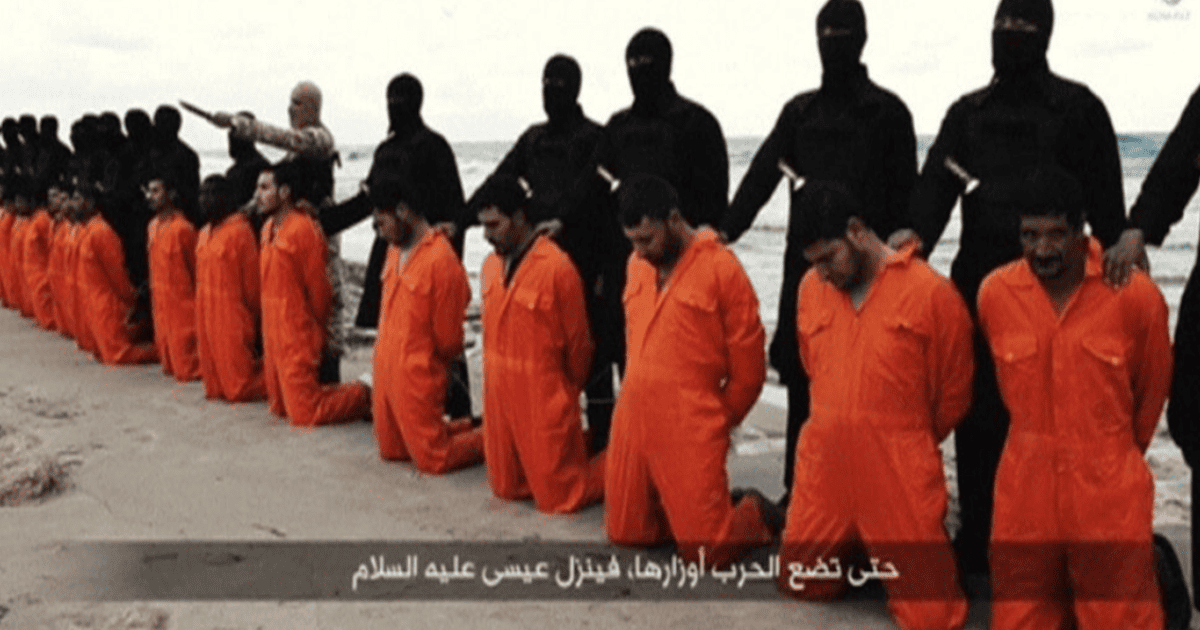
You will know a tree by its fruits. In February 2015 Islamic State cowards marched twenty-one men in orange jumpsuits along the shore near Sirte, in Libya, and made them kneel facing the sea. Twenty were Coptic labourers from Upper Egypt, thirteen of them from the single village of Al-Our, who had gone to Libya to earn money for their families. The twenty-first, Matthew Ayariga, came from Ghana.
Their captors held them for weeks and tortured them to make them renounce their faith and renounce Jesus Christ.
None did.
The snuff film of their mass murder released on 15th February, titled A Message Signed with Blood to the Nation of the Cross, shows several of them repeating "Lord Jesus Christ" as their heads were cut off their bodies with knives.
Within a week Pope Tawadros II declared them saints, and in May 2023 Pope Francis entered them in the Roman Martyrology, the Catholic Church's register of its martyrs.
The kneeling men followed a teacher who forbade his disciples the sword, prayed for his executioners, and warned whoever denied him before men would be denied before God.
The cowards holding the bloodied knives claimed the authority of a book which orders war on Christians and Jews until they pay tribute "while they are humbled", and of a "prophet" who led armies.
One book formed the men who died. The other was invoked by the men who killed them.
Last year, thirty-five Christians were killed by Islamists in a week of violence in Ituri Province, north-eastern Democratic Republic of the Congo (DRC) when Islamic terrorists from the Islamic State Central Africa Province (ISCAP) raided the village of Mamuku on the 20th of July, beheading 15 Christians and burning down 30 homes.
On the same day, ISCAP fighters captured and killed another 10 in the village of Soma, burning down 20 homes.
Four days later, a further 10 “Christian combatants” were beheaded in an attack on the village of Lukaya.
Beheading has a particular significance in Islamic scripture, law, and history. The Qur’an explicitly refers to striking enemies’ necks in battle (8:12 and 47:4), while classical Islamic jurisprudence recognised execution by sword as a legitimate method of capital punishment.
Historically, beheading became associated with Islamic military victory, judicial authority, and the punishment of enemies. The 2013 murder of British soldier Lee Rigby, whose Islamic attackers attempted to decapitate him, fits this wider pattern of jihadist violence. Its scriptural and historical associations help explain why extremists choose it as a particularly symbolic form of killing. This is not a small bunch of bad apples; it is an entire religion.
This month, the Pew Research Center published new projections showing Islam will overtake Christianity as the world's largest religion in 2035.
Conversion plays almost no part in it.
| Year | Christians | Muslims |
|---|---|---|
| 2020 | 2.27bn | 2.02bn |
| 2035 | 2.52bn | 2.57bn |
| 2070 | 2.96bn | 3.64bn |
Source: Pew Research Center, November 2026.
Headcounts reveal who will be more numerous. They say nothing about what either group believes a man may do to his daughter, his wife, his neighbour, or the stranger who mocks his God.
On every one of those questions Christianity and Islam give different answers, and the differences run from the first principle of morality all the way down to the rules of evidence in court.
Human beings only live peaceably side by side when they share a moral law.
They can quarrel about tax, football, and the proper length of a sermon, because they agree on what counts as murder, theft, cruelty, and mercy. Where two peoples disagree on those definitions, goodwill cannot cover the gap.
A community which regards a particular killing as justice cannot live quietly beside a community which regards the same killing as murder. One side will think its neighbours are shielding criminals. The other will think its neighbours are criminals.
No quantity of interfaith tea dissolves the problem, because the problem sits inside the meaning of good and evil.
Britain's political class works from the opposite premise: secular liberal universalism. Every religion, on this view, is a regional variety of the same decency, and any friction comes from poverty, prejudice, or poor manners.
Saudi Arabia, a rather better-informed judge of Islam than the Cabinet Office, disagrees.
It forbids the public practice of any religion other than Islam and permits no house of worship except mosques. Riyadh understands perfectly well Christianity contradicts its order, and acts on the understanding.
Whitehall has yet to grasp the same fact from the other side.
There is no living with this religion or its adherents. There is no "moderate" version of it. Its followers are responsible for murder and terrorism in its name everywhere they are found all over the globe. The Muhammedian snake has been allowed in, and we now have a Herculean battle to get it out again.
How Does One Know Good From Evil?
By feeling, of course, as David Hume said. Every moral system must first answer one question: how does a man know what is good? We call this the Moral Law. Christianity answers: by a law written on his heart before any scripture reaches him.
Paul tells the Romans the Gentiles, who never heard of Moses, still "do by nature the things contained in the law", their conscience bearing witness.
Thomas Aquinas built on this the doctrine of natural law: the first precept of practical reason is to do good and avoid evil, and every rational creature can grasp it. In Christian theology God forbids murder because murder is evil, and a pagan, an atheist, or a Hindu can see it is evil without opening a Bible.
For God knows that when you eat from it your eyes will be opened, and you will be like God, knowing good and evil.
The Moral Law belongs to the whole human race. Christianity therefore expects to find common moral ground with outsiders, and frequently does.
Sunni Islam answers differently.
The Ash'ari school, which became orthodoxy after the rationalist Mu'tazila lost the ninth-century struggle known as the Mihna, holds acts carry no good or evil in themselves. An act is good because God commands it and evil because God forbids it, and human reason cannot discover either on its own.
The Maturidi school, dominant among the Hanafi Muslims of South Asia and therefore among most Muslims in Britain, allows reason a larger part, yet still places the binding content of obligation in revelation.
The Quran states the consequence plainly: once God and his Messenger have decided a matter, no believing man or woman has any choice about it. Another verse denies true faith to anyone who does not make the Prophet judge of his disputes and submit in full.
A Christian who meets a cruel command must test it against a conscience his own faith says God wrote. When an Ash'ari jurist meets a text ordering the death of an apostate, the command itself makes the killing good.
He has no higher court of appeal, because his school recognises none.
Zero Penal Code Vs A Faith Built On One
The early Church took a decision with consequences for the whole of Western law. At the Council of Jerusalem, the apostles released Gentile converts from the Law of Moses, keeping only a handful of requirements. Paul went further: "the letter killeth, but the spirit giveth life".
The New Testament contains no criminal code, no tariff of punishments, no inheritance tables, and no rules of evidence.
Christ declined political power outright.
"My kingdom is not of this world", he told Pilate, and when tested over taxes he divided obligation between Caesar and God.
Christian peoples were left to make their own laws by reason, custom, and consent. The common law of England grew from the decisions of judges, and Parliament legislates without first asking a bishop to find a supporting verse.
Islam arrived with the law attached.
The Quran tells Muhammad he has been set upon a sharia, an ordained way, and orders judgement by what God has revealed, declaring those who judge otherwise disbelievers, wrongdoers, and rebels.
Muhammad was prophet, legislator, judge, head of state, and commander of armies at once.
The sharia governs prayer and fasting, and also contracts, marriage, divorce, inheritance, crime, warfare, and the treatment of unbelievers.
Caesar was left with nothing to render.
A Christian can live under a secular Parliament without breaking a single command of his founder. A devout Muslim under English law lives under a code his religion did not write.
Classical jurists treated residence under unbelievers' law as a concession to necessity, and argued over whether a Muslim might stay there at all.
When Christian kings retook Spain, the Maliki jurist al-Wansharisi ruled Muslims living under them were obliged to emigrate.
Love Your Enemies Vs Repay Them in Kind
Christ's command is unambiguous and deeply inconvenient: "Love your enemies, bless them that curse you, do good to them that hate you". He set aside an eye for an eye and told his followers to turn the other cheek. Asked how often to forgive, he answered seventy times seven, and he made God's forgiveness of us conditional on our forgiveness of others.
On the cross he prayed for the men who had nailed him there. Paul told Christians to leave vengeance to God and feed a hungry enemy. When a lawyer asked Christ to define a neighbour, he told the parable of the Good Samaritan, whose hero belongs to a despised rival sect.
The Quran grants retaliation as a right.
Whoever attacks the believer may be attacked in the same measure. The recompense for an evil is an evil equal to it, though the one who pardons will find his reward with God.
A further verse urges the believer to repel evil with what is better. Forgiveness is commended.
Love of the enemy is never commanded.
Defenders reach next for Quran 60:8, which permits kindness and justice towards unbelievers who have not fought Muslims over religion or driven them from their homes. The following verse, 60:9, forbids friendship with those who have.
Kindness is extended to the unbeliever on condition of his good behaviour. Christ's command covers precisely the man who is fighting you.
The Quran also limits friendship.
Believers must not take Jews and Christians as allies, nor unbelievers as allies in place of believers. Muhammad's companions are praised for being forceful against the disbelievers and merciful among themselves.
One faith tells its followers to love those outside it. The other tells its followers to show mercy within the fold and hardness beyond it.
Communities formed by those two instructions will not behave alike towards each other, however warm the civic receptions.
Murder As An Offence Against God Vs Debt Owed to the Family
In Christian moral law, murder offends God and the whole community. English law follows: the Crown prosecutes, and no relative of the victim can pardon the killer or sell him his freedom.
Islamic law treats deliberate homicide differently.
Another verse gives authority to the heir of anyone killed unjustly.
Classical jurisprudence turned these verses into a system, known as qisas: the victim's heirs may demand execution, accept blood money (diya), or forgive outright.
Murder becomes a claim owned by a family.
Three further rules follow.
- A hadith in Tirmidhi declares a father does not suffer retaliation for killing his son.
- Another, in Bukhari, lays down no Muslim is to be killed in retaliation for killing a disbeliever.
- Several classical schools set the blood money for a Jew or Christian at a half or a third of a Muslim's.
Pakistan's qisas and diyat provisions made murder compoundable in 1990, and honour killers were pardoned by the legal heirs, usually their own relatives.
After Qandeel Baloch was strangled by her brother in 2016, Parliament tightened the law. Her parents pardoned him regardless. In 2022 the Lahore High Court set aside his confession, found the remaining evidence too thin to prove an honour motive, and gave effect to the family's pardon.
With the honour charge gone, the ordinary qisas rules applied, and a man who had confessed on camera to strangling his sister walked free.
In Iran in 2020, Reza Ashrafi beheaded his 14-year-old daughter Romina as she slept. A father being exempt from retaliation, he received nine years.
Apostasy Is Free in One, Fatal in the Other
Christian teaching treats faith as a free act or as nothing at all. The Second Vatican Council's Dignitatis Humanae states nobody may be forced to embrace the Christian faith against his will. Christ told his disciples, when a town rejected them, to shake the dust off their feet and walk on.
Leave the Church of England today and the gravest consequence is a shorter Christmas card list. As the old joke goes, "You're an atheist? You should join the Church of England."
In Islam the door swings one way. Bukhari records their warlord's ruling:
Whoever changes his religion, kill him.
The four Sunni schools and the principal Shia school all classically prescribed death for the adult male apostate, differing chiefly on whether to allow three days for repentance and what to do with women.
Classical law also dissolved the apostate's marriage and cut off his inheritance, and in the 1990s Egypt's courts ordered the scholar Nasr Hamid Abu Zayd divorced from his wife for apostasy, though he insisted he remained a Muslim.
Several states keep death for apostasy today.
Apologists reach for Quran 2:256: there is no compulsion in religion. Classical commentators read the verse as forbidding forced conversion into Islam, and some held it abrogated altogether.
The entrance carries no compulsion. The exit carries a sword.
Forgiven at Calvary, Punished at Medina
Roman soldiers spat on Christ, crowned him with thorns, dressed him in a scarlet robe, and saluted him as a joke king. He answered with a prayer for their pardon. Parliament abolished the common-law offences of blasphemy and blasphemous libel in 2008, and the Church of England survived it.
In Sunan Abu Dawud, a blind man kills the slave woman who bore his children because she kept insulting the Prophet, and Muhammad declares no retaliation is due for her blood.
In Bukhari, Muhammad asks for a volunteer to kill Ka'b ibn al-Ashraf, a poet who had offended him, and finds one. The fourteenth-century jurist Ibn Taymiyya devoted an entire treatise, The Drawn Sword Against the Insulter of the Messenger, to proving such a man must die even after repenting.
Pakistan wrote the principle into statute. Its section 295-C prescribes death for defiling the Prophet's name.
Asia Bibi, a Christian farm labourer, spent eight years on death row under it before her acquittal. Salmaan Taseer, governor of Punjab, spoke up for her and was shot dead by his own bodyguard, Mumtaz Qadri, in January 2011.
Qadri was hanged in 2016 and now has a shrine.
Ayatollah Khomeini's fatwa against Salman Rushdie, a British subject, was issued on 14th February 1989, and Rushdie was stabbed on stage in New York in 2022.
On 24th March 2016 Tanveer Ahmed drove from Bradford to Glasgow and stabbed the Ahmadi shopkeeper Asad Shah to death, telling police Shah had disrespected the Prophet.
In 2021 a religious studies teacher at Batley Grammar School showed a cartoon in class and fled into hiding with his family. Three years later Dame Sara Khan's review found him still in hiding, failed by his school, his council, and the police.
A report for the Commission for Countering Extremism counted at least eleven anti-blasphemy plots, attacks, and illegal threats of violence in Britain since The Satanic Verses, with flashpoints at Batley, at a Wakefield school over a scuffed Quran, and at cinemas screening The Lady of Heaven.
Parliament repealed the blasphemy law.
Intimidation has re-enacted it, with a harsher price.
Equal Before the Law vs Protection Racket
Christian moral teaching knows no class of subject whose worth depends on his creed. Paul's formula, neither Jew nor Greek, bond nor free, refuses any such ranking before God, and English law long ago carried the principle into the courtroom.
Islam's founding settlement for Christians and Jews appears in Quran 9:29: fight them until they pay the jizya, a poll tax, "willingly while they are humbled".
The resulting status of dhimmi bought protection at a price.
The Pact of Umar, the classical template, forbade Christians to build new churches, display crosses in public, sound their church clappers above a murmur, or try to convert a Muslim, and required them to rise from their seats when Muslims wished to sit.
The homicide rules belong on the same list: no retaliation against a Muslim for killing a non-Muslim, reduced blood money, and, in classical courts, no testimony from a non-Muslim against a Muslim.
A Christian under classical Islamic rule was tolerated in the way a lodger is tolerated: on sufferance, at a rent, and on condition of keeping quiet.
Love Of Women Vs Hatred Of Women
Christ took marriage back to its origin: one man, one woman, one flesh, with divorce allowed only for adultery. Paul told husbands to love their wives as Christ loved the Church and gave himself for it, which turns a husband's authority into a duty of self-sacrifice.
The Quran permits a man up to four wives at once, plus the captive women he owns.
It places men in charge of women and sets out the remedy for a disobedient wife: admonish her, leave her bed, and strike her.
A son inherits twice a daughter's share.
In a commercial contract, two women's testimony replaces one man's.
A husband may divorce by pronouncement, the talaq, while a wife must seek release, usually by giving back her dower.
Most schools require a woman to have a male guardian to marry, citing the hadith "no marriage without a guardian". A Muslim man may marry a Christian or Jewish woman; a Muslim woman may marry no non-Muslim man at all.
Women are told to draw their head coverings over their chests and hide their adornment from men outside the family.
Bigamy is a crime under section 57 of the Offences Against the Person Act 1861, yet a man may contract several Islamic marriages without registering any, and English law neither recognises nor punishes them.
The government's own independent review of sharia councils, chaired by Professor Mona Siddiqui in 2018, found most of their work consisted of women seeking religious divorces, and recommended compulsory civil registration before or alongside every Islamic ceremony.
Captives, Concubines, Child Brides
New Testament sexual morality confines intercourse to marriage: "let every man have his own wife, and let every woman have her own husband". It does so practical reasons: adultery and divorce are phenomenally destructive, sexual disease can be rampant, and unwanted pregnancies end in death.
It is a protective measure confirming and blessing the beautiful gift of sex for producing the fruit of children. It is not merely a pastime you do with friends.
The Quran adds a second category.
Believers guard their chastity except with their wives or those their right hands possess, and married women are forbidden to them except those their right hands possess, words classical commentators applied to women captured in war.
Islamic law built an entire system of concubinage on these verses.
Islamic State revived it in 2014, enslaving thousands of Yazidi women and publishing pamphlets which quoted the classical rules chapter and verse.
Saudi Arabia abolished slavery in 1962 and Mauritania in 1981. Britain had done it in 1833, after a campaign led by the evangelical Christian William Wilberforce and his allies produced the Slavery Abolition Act. We had a problem with slavery.
On the age of marriage, Bukhari records Aisha was married to Muhammad at six and the marriage consummated when she was nine. We certainly have a problem with paedophilia.
The Quran sets a waiting period after divorce for wives who have not yet menstruated, a provision classical exegetes applied to girls before puberty. Classical jurisprudence fixed no minimum age for marriage, only a test of physical readiness for consummation.
England and Wales raised the minimum to 18, with no exceptions, under the Marriage and Civil Partnership (Minimum Age) Act 2022.
Iran's civil code lets girls marry at 13, and younger with a judge's consent.
Stones, Lashes, Severed Limbs
Christ was shown a woman caught in adultery, whose sentence under the Law of Moses was stoning. He answered, "He that is without sin among you, let him first cast a stone at her", and sent her away with an instruction to sin no more.
A thief crucified beside him received a promise of paradise.
The Quran prescribes a hundred lashes for fornication and amputation of the hand for theft. Those who wage war against God and his Messenger may be killed, crucified, or have hands and feet cut off on opposite sides.
The caliph Umar, in a sermon preserved by Bukhari, insisted stoning for married adulterers was revealed law and warned against anyone who would deny it.
A hadith in Abu Dawud orders death for both men in a homosexual act. Brunei wrote stoning for adultery and sodomy into its penal code in 2019. Saudi Arabia and Iran still cut off hands.
Both faiths call fornication, adultery, and sodomy sins.
One answers the sinner with mercy and an order to reform. The other answers him with a whip, a stone, or a blade.
Truth, Oaths, Permitted Concealment
The Ninth Commandment forbids false witness. Christ went further: "let your yes be yes and your no be no", and swear not at all. He warned whoever denies him before men will be denied before the Father, and generations of martyrs went to their deaths rather than offer a pinch of incense to the emperor.
Islam condemns lying as a general rule, then grants exceptions Christianity does not.
The Quran excuses the believer who utters disbelief under compulsion while his heart rests secure in faith, and permits outward friendship with unbelievers as a precaution against them, the textual root of taqiyya.
Lying is a problem in a high-trust society like those in the Britannic nations. We believe lying is a moral wrong. Islam believes it is permissible when you are a guest.
Their scripture also tells believers God has ordained for them the dissolution of their oaths by expiation.
A Christian martyr dies sooner than deny Christ. Islamic law allows a Muslim under threat to deny Islam and live.
Courts, contracts, and oaths of citizenship all depend on what a man believes a sworn word to be worth, and the two traditions price it differently.
Clean Plates, Clean Hearts, Compulsory Alms
Christ abolished the food laws in a sentence, declaring all meats clean, and taught defilement comes from what proceeds out of the mouth, meaning the words and intentions of the heart. Peter's vision at Joppa confirmed it.
Christianity has no dietary code, no rite of slaughter, and no list of unclean animals.
Islam forbids pork, blood, and carrion, calls wine the work of Satan, and regulates slaughter, ablution, and ritual impurity in detail.
A legal obligation, once a community grows large enough, as we have now seen, becomes a request made of schools, hospitals, caterers, and councils, and then an expectation.
Piety follows the same divide.
Christ told his followers to give alms in secret and to pray in a closet with the door shut. Islamic almsgiving, zakat, is a fixed compulsory levy, and one of its eight lawful recipients is "the cause of God", which classical jurists read as the funding of holy war.
Prayer is public, five times a day, and the Friday congregation is obligatory for men.
A Crucified Teacher Vs Conquering Statesman
Each faith asks believers to imitate its founder. Paul wrote, "be followers of me, even as I also am of Christ". The Quran calls Muhammad an excellent example for anyone who hopes in God, and his recorded words and deeds, the sunnah, form a source of binding law second only to the Quran itself.
The two lives point in opposite directions.
Christ raised no army, held no office, and ordered Peter to put his sword back into its place, warning those who take the sword will perish by it. He washed his disciples' feet and died under a Roman sentence, forgiving.
Muhammad governed Medina, led his forces at Badr, Uhud, and the Trench, and sent raiding parties against his opponents. After the Jewish tribe of Banu Qurayza surrendered, the judgement he approved, recorded in Bukhari, was death for the fighting men and captivity for the women and children.
The Quran declares fighting prescribed for you, though you dislike it.
It describes believers whose lives God has bought in exchange for paradise: they fight in the cause of God, and they kill and are killed. Those slain in God's way are alive with their Lord.
The Christian martyr is killed. The Islamic shahid may die killing.
Classical jurists divided the world into the Abode of Islam and the Abode of War, and through the doctrine of abrogation many classical commentators held the later Medinan verses on fighting overrode the earlier Meccan counsels of patience.
75% Of The UK's National Security Problem
The standard reply goes: Christians crusaded, burned heretics, and kept slaves, and both faiths have therefore killed in God's name. The record is real.
The comparison fails anyway.
A Christian who burned a heretic disobeyed the plain words of the man he claimed to follow, and every reformer who stopped him could quote the Gospels in his support.
An Islamist who kills an apostate or a cartoonist can cite his texts by chapter and number, backed by the consensus of the classical jurists.
The Muslim reformer must argue against his founder's example. The Christian reformer argues from it.
The favourite modern exhibit, Anders Breivik, described himself as a "cultural Christian" with no personal faith, and quoted no command of Christ for his massacre, because none exists.
British official figures show where domestic terrorism actually comes from.
| Measure | Figure |
|---|---|
| Muslim population, 2021 | 6.5% |
| MI5's counter-terrorism caseload, 2023 | about 75% |
| UK terrorist attacks, 2018 to 2023 | 67% |
Sources: ONS Census 2021; CONTEST 2023.
Saudi Arabia Bans Churches And Sponsors Extremism On British Streets
A Muslim in London may build a mosque, broadcast a sermon, publish a book attacking the Trinity, and invite Christians to convert. The Muslims in Britain directory counted some 1,850 mosques, prayer rooms, and shared halls across the UK and Ireland in February 2026.
A Christian in Riyadh may do none of those things.
Saudi Arabia keeps a prohibition on public non-Muslim worship, criminalises blasphemy, and runs a religiously based male guardianship system, while by some estimates around 1.5 million Christians, nearly all foreign workers, live there without a single lawful church.
A 2017 Henry Jackson Society report named Saudi Arabia the foremost foreign sponsor of Islamist extremism in Britain, through endowments to mosques and Islamic schools which hosted extremist preachers and distributed extremist literature.
The Home Office had commissioned its own study of foreign funding, and then declined to publish it.
Reciprocity is the simplest test of whether two moral orders can share anything at all.
Britain passes it.
Saudi Arabia does not even attempt it.
At Least Four Million And Rising Fast
There's no denying how insane this really is when you look at the numbers and extrapolate. It's not alarmism to point out what happens when Muslims become a significant minority, let alone large enough to challenge the host.
| 2011 | 2021 | |
|---|---|---|
| Christian share of England and Wales | 59.3% | 46.2% |
| Muslim share of England and Wales | 4.9% | 6.5% |
| Muslims in England and Wales | 2.7 million | 3.9 million |
Source: ONS Census 2021.
The Muslim Council of Britain's 2026 census report put the UK's Muslim population at four million, with nearly half under the age of 25.
National averages conceal concentration. In Birmingham, Britain's second city, 29.9% of residents were Muslim in 2021, after growth of 45.8% in a decade.
Doctrine reaches the wider population by three routes, all already in operation:
- The tribunal settles marriages and divorces English law never sees.
- The family enforces what the tribunal decides.
- The threat persuades a school, a cinema chain, or a council to comply.
None of the three needs a national majority. Each works best where a community is concentrated, young, and growing.
Opinion has arrived with the people. The Economist's poll by Number Cruncher recorded the following among British Muslims.
- 29%: Sharia should be the main basis of British law, or one influence alongside others
- 44%: Sharia should apply only to personal matters, for Muslims who choose it, where compatible with British law
- 33%: Support political Islam
- 62%:A Muslim woman should wear the hijab before men outside close family
The 44% offer less comfort than their answer suggests: in Islamic law, personal matters means marriage, divorce, custody, and inheritance, the precise ground where its rules collide most directly with English law.
Four wives, divorce by pronouncement, and a daughter's half share are not compatible with British law, however the question is phrased.
And a choice made inside a community whose law prescribes death for leaving it is a choice of a peculiar kind.
Two thirds of British Muslims are militant.
A third of them are radical extremists.
Separation Comes By Agreement Or Blood
Two moral orders sharing one territory have rarely stayed together once neither would yield. In March 1940 Muhammad Ali Jinnah told the Muslim League at Lahore Hindus and Muslims:
...belong to two different religious philosophies, social customs, literatures.
They could not be yoked into a single nation.
British officials spent years pretending otherwise, then partitioned India in a matter of weeks in 1947. Some fifteen million people were uprooted, and somewhere between several hundred thousand and two million were killed.
Lebanon tried confessional power-sharing instead, and got fifteen years of civil war from 1975.
Cyprus was divided by invasion in 1974 and remains divided.
In each of these cases the separation came. Statesmen chose only its timing and its manner, and they chose late.
One Kingdom Needs One Moral Law
On 6th May 2023 Charles III swore to maintain "the Laws of God and the true profession of the Gospel", in the form required since the Coronation Oath Act 1688.
The kingdom has a moral law, sworn to before God by its head of state.
It rests on a God who wrote his law on every heart, forbade his followers the sword, forgave his mockers, and left Caesar to govern by reason.
The rival law rests on a false god whose commands make good whatever they order, and on a founder who governed, legislated, judged, and fought.
It prices a life by the faith and kinship of its owner, bars the exit from religion, punishes the insult, ranks women and unbelievers beneath believing men, and permits deception in war and the dissolution of oaths.
Its adherents may be excellent neighbours, for a time. Its law cannot be one.
Neither code can absorb the other.
Christianity cannot accept the death of the apostate without ceasing to be Christian. Classical Islam cannot drop it without repudiating its Prophet's ruling and the consensus of its jurists.
Integration programmes, interfaith forums, and cohesion strategies all rest on the hope one side will quietly abandon its scriptures. Decades of them have produced sharia councils, a teacher in hiding, and a shopkeeper stabbed to death in Glasgow.
Where two moral laws contend for one territory, three outcomes exist:
- One subdues the other.
- They fight,
- They separate.
Britain will not accept the first and must not risk the second. Separation remains, and it has to be chosen deliberately, under law, and soon, while statesmen can still arrange it and before events impose it.
That means expulsion of the religion from British territory and defence against its re-entry. As peacefully as is possible. Its buildings; its courts; its public worship; its symbols; its idols; its clothing; its language; its scripture; its art; its organisations and charities; its acceptability in public office.
A people with one moral law can absorb newcomers for centuries, provided the newcomers adopt the law. A people made to host two will in time find itself governed by whichever is enforced with more conviction.
Parliament abolished blasphemy in 2008. In Glasgow, Batley, and Wakefield, others have been enforcing it since.
You will know a tree by its fruits.
The fruits of Islam are conflict, tyranny, murder, terror, and death.
It starts with the King of England, the Defender of the Faith, finding the courage to say so.